






Regular price
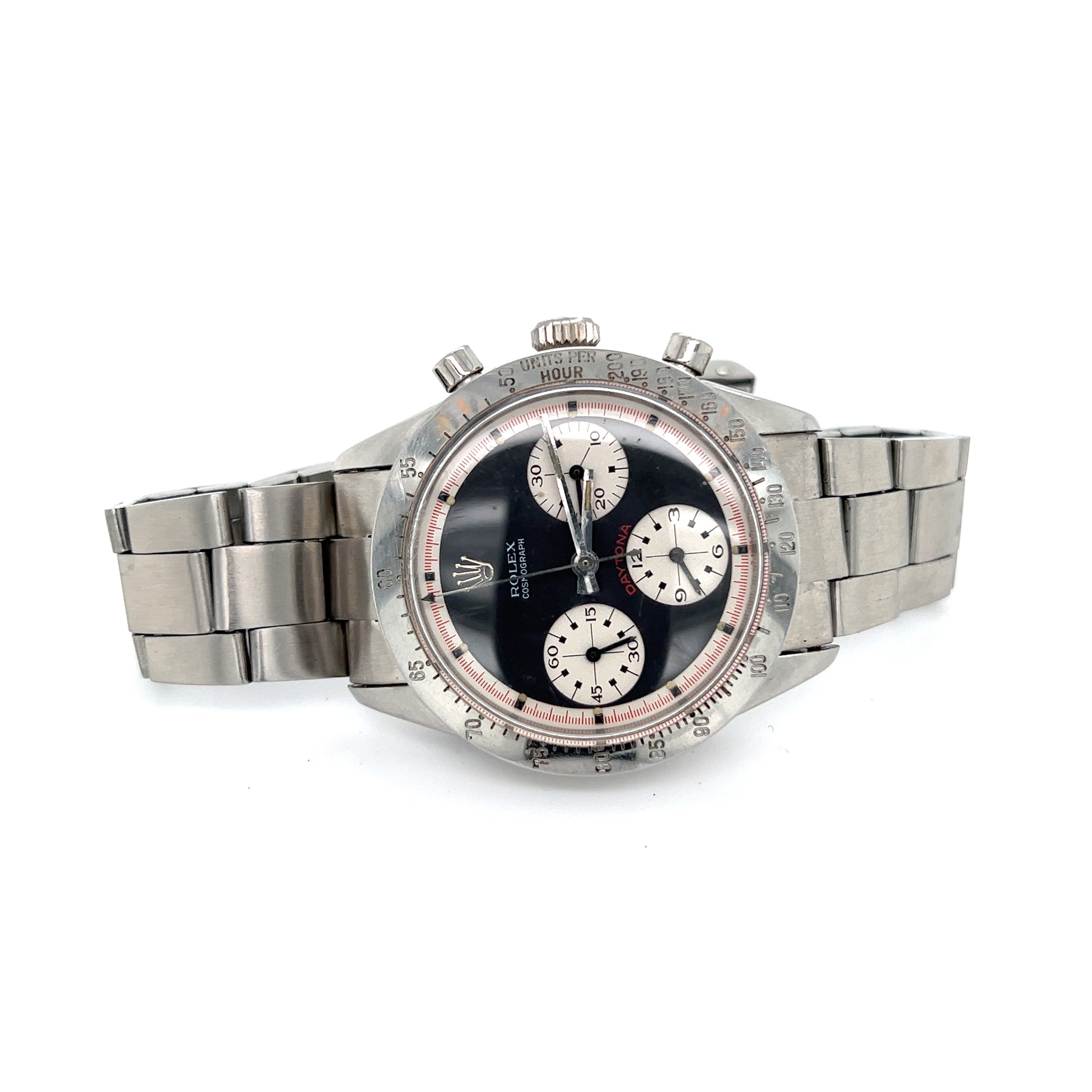
1969 Rolex 'Newman Dial' Daytona 6239 Stainless Steel Uber Rare
Due to unprecedented volatility in the precious metals markets, item pricing may not be up to date. We make every effort to keep our pricing accurate, but please contact us to confirm the most up-to-date pricing.
Rolex "Newman" Daytona
Reference 6239
Born Circa 1969
Serial Number 1,958,XXX
Size 37mm
Authentic Factory Newman Dial, engraved Singer on back
Condition Excellent
One Year Warranty
Original Oyster Fold Over Link Bracelet + Bund Watch Strap
Ours is in excellent condition with very strong lugs, original dial, hands, push buttons + original box, each authenticated and guaranteed original.
Every legend has an origin, and for the Rolex Daytona, that origin is the reference 6239. Introduced in 1963, it was the very first Cosmograph, the watch that launched the most celebrated chronograph line in the world. This 1969 example, crafted in stainless steel, is fitted with the famous exotic dial that collectors now know as the "Paul Newman," the same reference and dial style worn by the actor himself. It brings together the founding reference of the Daytona and the most sought-after dial in vintage Rolex collecting, making it one of the most historically important vintage watches a collector can own.
When Rolex introduced the Cosmograph in 1963, it changed the look of the racing chronograph. The 6239 was the first Rolex to move the tachymeter scale from the dial to the bezel, engraving it on a polished steel ring around the crystal. This freed the dial from clutter and gave it a cleaner, more legible design, while still allowing the driver to calculate average speed over a measured distance. The watch was also the first Rolex chronograph to wear the word "Cosmograph" on its dial, and before long it took on the name of Daytona Beach in Florida and its storied history of motor racing. That combination of function and style laid the foundation for every Daytona that followed.
Alongside the standard dials, Rolex offered the 6239 with an alternative exotic dial produced by the dial maker Singer. It was instantly recognizable for its square-tipped markers on the subdials, its Art Deco–style numerals, and its stepped construction, with the subdials and outer track sunk into the main surface for a striking three-dimensional effect. At the time, the exotic dial was a slow seller, and relatively few were fitted. Estimates suggest that only around 15 percent of the 6239s produced left the factory with this dial. Decades later, those very qualities that once made it unusual turned it into one of the most coveted designs in the world.
The exotic dial owes its nickname to Paul Newman, the actor, racing driver, and philanthropist, who wore a 6239 with this dial in his private life and in promotional materials for the racing film Winning. As collectors began to notice the distinctive dial on his wrist, it became known simply as the Paul Newman dial. In October 2017, Newman's own Daytona sold at auction in New York, at the time becoming the most expensive Rolex wristwatch ever sold, and the name Paul Newman became inseparable from the Daytona's legend.
The dial on this watch is a beautiful example of the design. Its black surface sets off three silvered subdials with square-tipped markers and Art Deco–style numerals, framed within a silvered outer track that carries fine red graduations for timing fractions of a second. The running seconds subdial sits at nine o'clock, the 30-minute chronograph counter at three o'clock, and the 12-hour counter at six o'clock. The Rolex coronet and the Rolex Cosmograph signature sit beneath twelve, while the word Daytona appears in red above the six o'clock subdial, adding a vivid accent to the monochrome palette. The luminous markers and the polished baton hands with luminous inserts have aged gently over the decades, giving the dial a warm, authentic character.
Inside is a manually wound, Valjoux 72–based column-wheel chronograph from Rolex's 722 family, with 17 jewels and a frequency of 18,000 vibrations per hour. Column-wheel control is the traditional choice for high-quality chronographs, giving the pushers a crisp, precise feel and coordinating the start, stop, and reset functions with mechanical elegance. Winding the watch by hand each morning is part of the ritual of owning a vintage Daytona, a tactile connection to the mechanical heart beneath the dial. Over the life of the 6239, Rolex refined the movement from the original Valjoux 72B to the Calibre 722 and then, from around 1967, the 722-1, before introducing the higher-frequency Calibre 727 around 1970.
The chronograph is operated by two pump pushers flanking the crown. The pusher at two o'clock starts and stops the chronograph, and the pusher at four o'clock returns it to zero. These pump pushers operate with a simple press, a period-correct feature of the earliest Daytonas before Rolex introduced screw-down pushers in later references. Together with the steel tachymeter bezel graduated in "Units Per Hour," they give the 6239 a clean, purposeful racing character that remains as appealing today as it was in the 1960s.
The stainless steel Oyster case measures 37 mm in diameter, a compact size that wears comfortably and elegantly on the wrist. It features a screw-down case back and a screw-down crown, and its alternating brushed and polished surfaces catch the light as the tachymeter bezel wraps around the dial. The watch is worn on a steel Oyster bracelet, a fitting companion to its sporting heritage. As one of the later 6239s, produced near the end of the reference's run, this 1969 example represents the culmination of the first Daytona before the transition to the next generation.
The 6239 also introduced a contrasting color scheme that would become one of the most recognizable looks in watchmaking: dark subdials on a light dial, or light subdials on a dark dial, as seen here. This panda-style contrast was the first of its kind on a Rolex chronograph, and it remains central to the Daytona's identity to this day. Combined with the exotic Paul Newman layout, it creates a dial of exceptional graphic strength, one that reads instantly from across a room yet rewards close inspection with its layered depth and fine details. Because every original exotic dial has aged in its own way over more than half a century, each surviving example is truly individual.
What makes this 1969 Rolex Daytona 6239 so compelling is the meeting of two great stories in a single watch. It is the founding reference of the Daytona line, the watch that introduced the tachymeter bezel and the Cosmograph name, and it carries the exotic dial that Paul Newman made famous. For collectors, it is a true grail, a piece that captures the very beginning of the most iconic chronograph in watchmaking and the moment it became a legend.
Trade for This Watch
Certified Authentic
Every piece is backed by our authenticity guarantee.