



Regular price
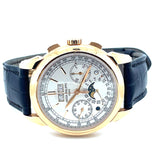
2018 Patek Philippe Grand Complications 5270R-001 Perpetual Calendar Chronograph Moon Phase Rose Gold Silver Opaline Dial
Due to unprecedented volatility in the precious metals markets, item pricing may not be up to date. We make every effort to keep our pricing accurate, but please contact us to confirm the most up-to-date pricing.
2018 Patek Philippe Grand Complications Perpetual Calendar Chronograph Moon Phase
Reference 5270R-001
Rose Gold
Silver Opaline Dial
Case Size: 41mm
Condition: Excellent, Unpolished
Alligator Strap
Complete Box + Outer Carton, Papers, Booklet, Stylus, and Extra Caseback
There is a particular kind of quiet that settles over a Patek Philippe perpetual calendar chronograph in rose gold with a silvery opaline dial. It is the sound of a formula that has been refined for more than eight decades, arriving at a point where nothing feels out of place. This 2018 Patek Philippe Grand Complications Reference 5270R-001 is exactly that kind of watch: a manually wound, in-house perpetual calendar chronograph in an 18k rose gold case, dressed in the warm-metal-and-silver palette that collectors have associated with the great Patek calendar chronographs since the middle of the twentieth century.
To understand why the 5270R-001 matters, it helps to start with the family tree. Patek Philippe launched the world's first serially produced perpetual calendar chronograph wristwatch, Reference 1518, in 1941, and the combination has remained one of the most prized in the manufacture's catalog ever since. The 1518 gave way to the 2499, the 2499 to the long-running 3970, and the 3970 to the 5970. Each of those watches depended on a chronograph base from outside the manufacture, most famously the Lemania-derived movements of the later references. The 5270, introduced in 2011, broke that pattern. It was built around Caliber CH 29-535 PS Q, which Patek describes as the first perpetual calendar chronograph movement developed and manufactured entirely in-house in its own workshops. That single fact makes every 5270 a pivot point in the history of the complication.
The 5270R-001 occupies its own distinct place within that story. The reference debuted at Baselworld 2015 as the first 5270 cased in rose gold, and it arrived as part of the model's third generation. That generational detail is more than trivia, because the 5270 dial evolved in public over its first few years. The original 2011 white gold version omitted the tachymeter scale its predecessor had carried. The second generation, launched in 2013, brought the tachymeter back, but merged it with the seconds track into one busy scale and introduced a downward bulge in the dial's outer tracks at six o'clock that collectors nicknamed the "chin." The 2015 third generation, of which this rose gold reference is a founding member, resolved both issues. The chin is gone. The seconds track and the tachymeter now run as two separate railroad tracks, with the seconds track neatly interrupted between roughly 27 and 33 seconds so the date and moon phase subdial can breathe, and the central chronograph hand is long enough to sweep cleanly out to the tachymeter at the dial's edge. Look at the dial in the photograph and you can see that solution at work: the tachymeter, marked "Base 1000," circles the perimeter uninterrupted, while the inner minute and seconds track yields gracefully to the subdial below.
The layout itself is the classic Patek calendar chronograph grammar, executed with remarkable balance. Twin apertures beneath twelve o'clock display the day and month. At nine o'clock sits the small seconds subdial, and at three o'clock the instantaneous 30-minute chronograph counter, both slightly recessed into the dial surface for depth and legibility. At six o'clock, a large subdial combines the date, read by a hand, with the moon phase, its golden moon traveling across a deep blue starry sky. Two small round apertures complete the picture: a day/night indicator at roughly 7:30, which shows blue during the night hours, and a leap year indicator at 4:30, which tracks the position of the watch within the four-year cycle. Applied faceted baton hour markers in rose gold and rose gold leaf-shaped hands catch the light against the silvery opaline background, giving the dial a soft glow rather than a hard reflection. It is a quietly confident composition, and in rose gold it reads as warmer and more romantic than the white gold versions that preceded it.
Turning the watch over reveals why serious collectors seek out the 5270. Caliber CH 29-535 PS Q is a manually wound movement measuring 32 mm in diameter and 7 mm in thickness, built from 456 parts with 33 jewels. It beats at 28,800 vibrations per hour, or 4 Hz, regulated by a Gyromax balance with a Breguet balance spring, and offers a power reserve of 55 to 65 hours with the chronograph disengaged. The architecture is deliberately traditional. Patek chose a column wheel to control the chronograph functions and a lateral, or horizontal, clutch to engage it, the configuration watchmakers and collectors have long admired for the theater of its action as seen through the caseback. That classical layout is paired with six patented innovations related to the chronograph, proof that Patek treated tradition as a starting point rather than a limit. The perpetual calendar module is a feat of its own, an exceptionally thin mechanism built from 182 parts in only 1.65 mm. All of it is finished to the standard of the Patek Philippe Seal, with polished bevels, Geneva striping, gold chatons and the hand-finished surfaces that reward a loupe.
A perpetual calendar, it is worth remembering, is the complication that never needs to be told what month it is. The mechanism accounts automatically for months of 30 and 31 days and for February in both standard and leap years, so that a watch kept running will display the correct date until the year 2100, when the Gregorian calendar skips a leap year. Small recessed correctors set into the case band allow the calendar displays to be adjusted should the watch be allowed to stop.
The case is just as carefully considered. It measures 41 mm in diameter and 12.4 mm in height, a step up in diameter from the 5970 while remaining slimmer than its predecessor. A concave bezel frames the dial and draws the eye inward, and the elegant two-tier lugs give the profile a sense of architecture when the watch is viewed from the side. Rectangular chronograph pushers flank the crown, and the case is water resistant to 30 meters. A sapphire crystal caseback displays the movement, and Patek has historically supplied an interchangeable solid caseback for those who prefer the discretion of closed gold. Patek's catalog specification paired the 5270R-001 with a hand-stitched matte brown alligator strap and a rose gold fold-over clasp; this example is shown on a black alligator strap, a pairing that sharpens the contrast between the rose gold case and the silver dial.
What ultimately sets this reference apart is its scarcity within the 5270 lineage. The silver-dialed rose gold 5270R-001 had a relatively short catalog life before Patek moved its rose gold 5270 toward darker dials, which means fewer examples of this exact configuration exist than of many other versions of the model. For collectors who want the timeless silver-and-gold look of the historic 1518, 2499 and 3970, combined with a fully in-house modern movement and the refined third-generation dial, the 5270R-001 is one of the most compelling answers Patek has ever offered.
On the wrist, the watch wears with the ease of a dress piece and the depth of a grand complication. Every glance gives you the day, the date, the month, the phase of the moon and the leap year position, with a chronograph ready at the press of a pusher, all within a case that slips comfortably beneath a cuff. It is a watch that will keep perfect calendar time for generations, and a fitting cornerstone for any serious collection of Patek Philippe Grand Complications.
Trade for This Watch
Certified Authentic
Every piece is backed by our authenticity guarantee.